
How playing bridge supported Fife woman’s recovery after a stroke and DNR notice

A retired Fife teacher who was placed under a do-not-resuscitate notice (DNR) after suffering a stroke and respiratory arrest has said playing bridge has helped her rebuild her life.
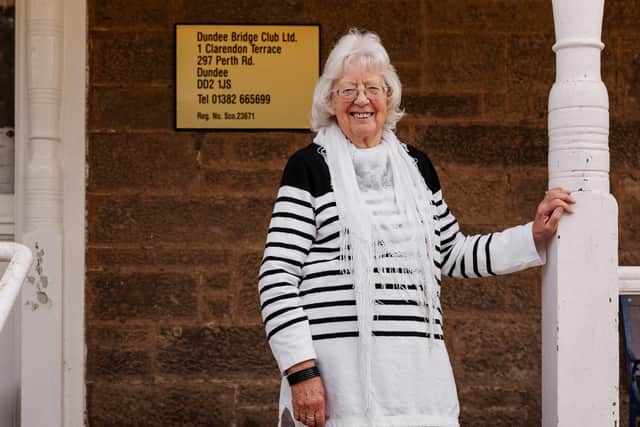
Alice Cowieson, 75, from Dairsie near Cupar, had taken up the card game to “keep her mind sharp” in retirement after a 25-year career teaching drama to primary school pupils across north east Fife.
She is now speaking out as part of a Scottish Bridge campaign to encourage more people to try the game which became a vital part of her recovery after a serious illness last year.
Alice was diagnosed with vasculitis in summer last year, a rare chronic condition affecting the blood cells, after initially believing she had a virus.

While receiving treatment, she suffered a stroke and later a respiratory arrest, leaving doctors at Victoria Hospital in Kirkcaldy trying to manage both a clot on her lung and a bleed on her brain.
She said: “The night I collapsed, there was a do-not-resuscitate notice over me. That probably tells you how serious it was. Before this happened, I was fit, healthy, enjoying life. Then suddenly I was very seriously ill. I had to accept that.”
Alice spent several weeks in hospital and later faced a long recovery, including fatigue, sight problems and difficulty concentrating.
But bridge, which she had first taken up 18 years earlier, became one of the things that helped her begin to feel like herself again.
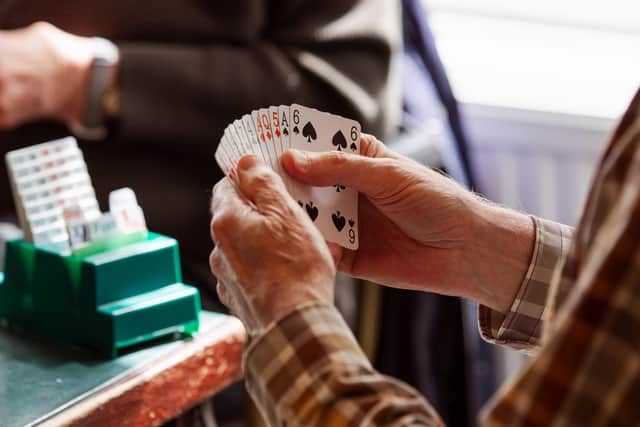
She said: “Bridge started as something to keep my mind sharp in retirement, but it became so much more than that. When I was seriously ill, it gave me something to work towards. I could only manage a few hands at first, but gradually my concentration came back. Getting back to the table felt like proof that I was still me.”
Alice first discovered bridge after retiring from teaching and stepping back from amateur dramatics, including directing and producing local productions in Cupar and Tayport.
She had begun to find it harder to remember lines on stage and wanted a new challenge.
She said: “I thought about Sudoku and Wordle and things like that, but I’d always loved cards. I saw bridge advertised through an over 50s community group and thought I’d give it a go I had no idea how big it was or where it would take me.”
What began as one lesson a week soon grew into regular practice sessions with other beginners over tea and cake.
Alice later joined Dundee Bridge Club, became editor of its magazine, The Grand Slam, and went on to serve as club president. She now plays up to five days a week, sometimes six, and has competed around Scotland, including against grand masters.
She said: “Bridge definitely keeps your brain working. There is so much skill to it. You have to be on the ball – you can't not. I know the difference in my play when I’m tired and when I’m not. When I’m really on it, I can feel it.”
During her hospital stay, Alice said the bridge community rallied round, visiting her, sending cards and even playing hands with her as she recovered.
She said: “The thing I found about being in hospital was that it was boring. It’s a long day and a long night when you don’t sleep. To have people come and visit for half an hour was great. Some came in threes so we could sit and play a game, just to prove I still could.”
She also began playing short online bridge challenges while in hospital, slowly rebuilding her concentration.
“At first I could only manage a few hands before my concentration went,” she said. “But gradually I built it back up. Bridge helped me recover mentally as well as physically.”
After three months away from the club, Alice returned first to a social session, then to an online competition with her regular partner.
She said: “When I finally got back to the table, it felt great. I felt as if I had succeeded in kicking this into touch. I can drive, I can walk, I can talk, I can play bridge five days a week and I can potter in the garden. I am so lucky.”
Alice said she hoped her story would encourage others to see bridge as an accessible game that can offer friendship, purpose and mental stimulation at any age.
She added: “Some people think bridge is socially elite, but it isn’t, it’s for everybody. I would say – ‘do it’. Get in there, get some lessons, find a partner, find a club. Learn the basics and then take it wherever you want it to go.”
For more information on how to get into Bridge, visit sbu.org.uk. For more information on vasculitis, visit vasculitis.org.uk.