
1926 General Strike: how landmark action brought Fife grinding to a halt 100 years ago

One hundred years ago this week, Kirkcaldy district was in the grip of the General Strike - one of the most significant moments in the history of the labour movement.
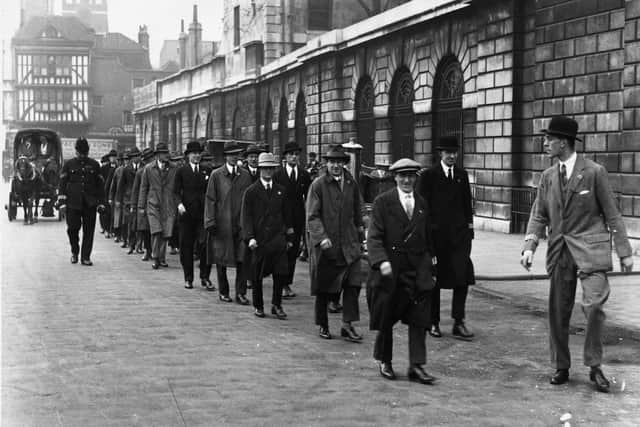
It lasted nine days, starting at midnight on May 3, 1926 and ended on the 12th as millions of workers walked out of their factories and key industries in support of miners who were facing daunting wage cuts and longer working hours.
It is impossible to conceive of such mass action today, but it has had a lasting legacy on the workplace, and its centenary will be marked with special screenings of a film made in Fife and set in those dark, challenging times.
First released in 2012, The Happy Lands was a huge community-led project which saw more than 1000 local residents get involved as researchers, performers, crew members and designers. Directed and produced by Robert Rae and Helen Trews, it is a powerful, community-made drama depicting the lives of mining families during the strike.

How the strike started:
The General Strike began when the Trades Union Congress (TUC) called on workers across key industries to down tools in support of the miners.
The coal industry was in crisis, and mine owners saw stringent pay cuts and long hours as two key ways to stay in profit. The miners took a very different instance, summed up by their slogan "not a penny off the pay, not a minute on the day."
Trouble was brewing long before talks broke down.
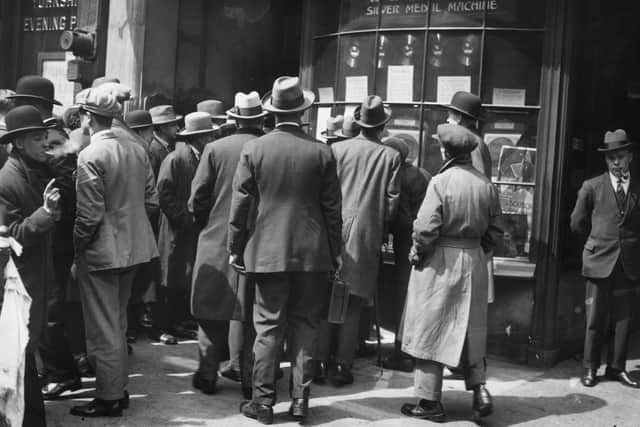
At the end of January, miners at Methil Colliery went on strike - 2300 men stood idle at Wellesley, which was owned by the Wemyss Coal Co Ltd.
The bosses said if the pit was to operate efficiently, two men would have to do work previously done by three. When the nightshift refused to go down, work ceased completely, and the gates were picketed to prevent any blacklegging - the derogatory term given to anyone who worked on during a strike. Others called them scabs.
The problems were evident beyond the coalface. Dysart Town Council expressed concerns over the small amount of shipping coming into the harbour because of poor coal supplies - trade was at its lowest since the depression.
By May, things had reached breaking point, with the TUC calling transport workers, printers, dockers, engineers and others whose labour kept the country running to strike in support of the miners.
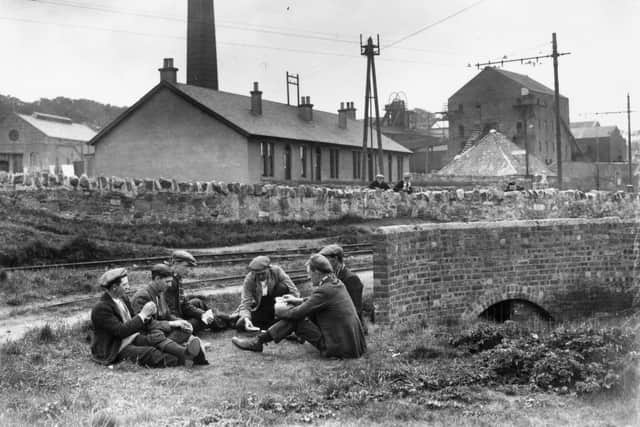
The impact was immediate. Public transport, which most people relied on, simply stopped, and huge swathes of the economy ground to a halt, prompting emergency measures from the Government which recruited volunteers to try to keep vital services running.
The impact across Kirkcaldy district:
The Fife Free Press spoke of the “extreme gravity” of the situation - “so grave indeed that the utmost caution was observed by those in expression of opinions of any kind”
It reported: “Responsible circles are extremely reticent, and even the public view with profound apprehension the pregnant possibilities of the situation.”
The pages of the Press underlined the impact the strike had - it was a time of deep concern.
Kirkcaldy Town Council met “under the shadow of national disaster” it reported, and dispatched its business within 12 minutes; “members were not inclined to verbosity” said the newspaper.
It spoke of events “kaleidoscopic in character” which changed by the hour.
“We were living at tremendous pressure., Next door neighbours slink about furtively,. Old friends put a guard on their utterances and actions, the entire cosmic scheme was disturbed. What had happened in so brief a space was a complete transmutation of values, national, ,local and social.”
It feared civilisation was “trembling in the balance” but added “the sanity of the nation saved it.”
In the end, the TUC called off the strike after nine days, and the miners returned - some to even worse conditions. This wasn’t a glorious victory, but it did define our workplaces for generations to come as people stood up en masse for their rights.
The coal industry continued for another five decades and moire, with the 1984 strike changing the landscape once more. Today, all that is left of an industry which employed thousands of men in Kirkcaldy alone is a small plaque on a playpark at Seafield where houses have replaced the old colliery.
Hold the front page
The General Strike hit many industries, including newspapers - for the first time in its history, he Fife Free Press failed to publish.
“The unbelievable has happened!” the Press declared. “Never in the history of the industry had newspapers been affected, but the cataclysmic disaster engulfed almost everyone and the Press went down in then torrent.” It said its readers were “frankly incredulous” as they went without their weekly read.
The aftermath
A glimpse of the division and bitterness can be gleaned from the court reports which followed.
A total of 31 strikers appeared at Cupar Sheriff Court accused of acts of intimidation and aggression. Ten railwaymen were charged and refused bail.
A blacksmith was jailed for two months for being in possession of documents which, if published, would be a contravention of the emergency regulations, a man was fined for holding up a passenger train, and another for holding up a motorbike and demanding to see the driver’s TUC permit.
And one miner ended up in court after being found in possession of a stone near the railway line, accused of threatening to do damage to a train.
He was seen lifting a huge stone and telling the crowd “come on and do your duty” - it was still in his hand when the police arrested him. His defence was the stone was there to strike matches on. It didn’t wash. He was jailed for two months.
Happy Lands:
The gala screening at the Adam Smith Theatre in Kirkcaldy, on Tuesday, May 26, will feature brass band music and banners to evoke the era of the strike - and audience members are urged to don black tie and add a touch of Hollywood glamour.
The film’s screening at Auchterderran Church Hall, Cardenden on Wednesday, May 6 will feature a Q&A and post-screening discussion with William Hershaw, poet playwright and Scots language activist. The series wraps at Lochgelly Centre on Thursday, June 4 with Q&A with the cast and crew.