
Exhibition marks 250th anniversary of Cupar Curling Club – one of oldest in world

A landmark anniversary is the subject of a new exhibition at Cupar Museum.
It celebrates the 250th anniversary of Cupar Curling Club, and runs until the end of October.
The north-east Fife club pre-dates significant historical events such as the American Declaration of Independence, the French Revolution, and even the early writings of Robert Burns. Founded in 1775, it is also the 10th oldest curling club in the world. It was originally established as the Curling Society of Cupar-Fife, and while records prior to 1854 are scarce, reports from as early as 1791 have been discovered in local newspapers.
The club’s early meetings were held at various local venues, including the Blue Bell Inn, McNab’s Hotel, Parker’s Hotel, the Tontine Hotel, and the Royal Hotel.


In 1822, the Town Council granted permission to flood the Haugh Park for curling, replacing the earlier site known as Fluthers Bog. Around 1825, Tarvit House, near Cupar, became an important site for curling, with ponds in the estate grounds used for the sport.
James Home Rigg of Morton and Downfield, a prominent figure in the club’s history, became its patron. The Home Rigg family contributed significantly to the club, with James Home Rigg of Tarvit, in the late 1800s, presenting several trophies still played for today.
In 1863, with the curling pond at Tarvit House no longer accessible, a new pond was constructed at Thomastoun, sometimes called Tailabout.
By 1882, the club introduced challenge matches, including fun events such as “married men vs. bachelors,” with proceeds donated to local charities.
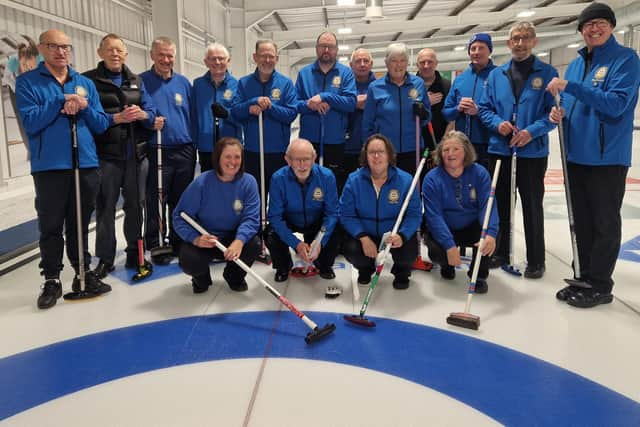
The late 1800s brought both successes and difficulties. Winters were particularly harsh, and many curling days enjoyed during this period. The club's popularity continued to grow, and by 1889, 12 clubs existed in the Cupar Province. Cupar had around 80 members - all of them men.
The first women played against Cupar in 1902, in a match against Lundin & Montrave. By 1908, three women were officially recorded as members - and 1958 www the club saw its first lady President, Mrs. H Law. Jenny Graham would later bring the club recognition by winning the Scottish Ladies Championship in 1964 and the British Ladies Championship in 1968.
In 1906, the club moved to a new artificial curling pond at Ladyinch - now Balgarvie Court - allowing for curling even without the need for extended cold weather.
By 1936, Cupar began competing in the Lomond League at the newly opened Perth Ice Rink, but WWII saw many of the town’s premises requisitioned by the military, and membership dropped to just 27. By 1952, five women were initiated into the club, marking a further step toward gender equality.
In 1975, Cupar Curling Club celebrated its 200th anniversary with a special dinner at the Royal Hotel in Cupar. In 1979, Jack Anderson, a longstanding member, became President of the Royal Caledonian Curling Club - the first and only Cupar member to hold this prestigious position.
By 2000, the club moved its home rink to Kinross, where it remains to this day. It enjoyed a major victory in 2014, winning the Falkland Kettle after more than 40 years of attempts.
The pandemic had a significant impact on curling clubs across the country, but Cupar continued to play its internal competitions and participate in leagues. New trophies have also been added to its collection in recent decades, while former member, James Boyd, represented Australia in the World Senior Championships and was selected to play again in the 2025 championships.
Cupar Curling Club's storied history is a testament to the dedication of its members and its enduring place in the world of curling. From its early days on Fluthers Bog to its modern-day success, the club remains a vital part of the town’s sporting community.
> Anyone interested in taking up the sport or joining the club can email [email protected]