
Smoking ban 20 years on: how 2006 law changed our lives for the better

An entire generation has grown up in a smoke free environment in work places, pubs, clubs, restaurants and cafes.
The ban which transformed our daily lives came into effect at 6:00am on March 26, 2006. The Smoking Health And Social Care (Scotland) Act 2005 was the then Scottish Executive’s most drastic action to tackle our reputation as the sick man of Europe.
Before the ban, smoke more than got in our eyes. From offices to aeroplanes, from cinemas and the upper decks on buses, to pubs, clubs and restaurants, non-smokers all knew they’d go home with their clothes stinking of smoke.
Today smokers have to go outside, with many huddled in specially built shelters, but, for generations, they simply stayed at their desks or lit up a fag while having a pint - in fact, the two went hand in hand as part of a night out. The ashtrays which were brim full on every table have long since disappeared.
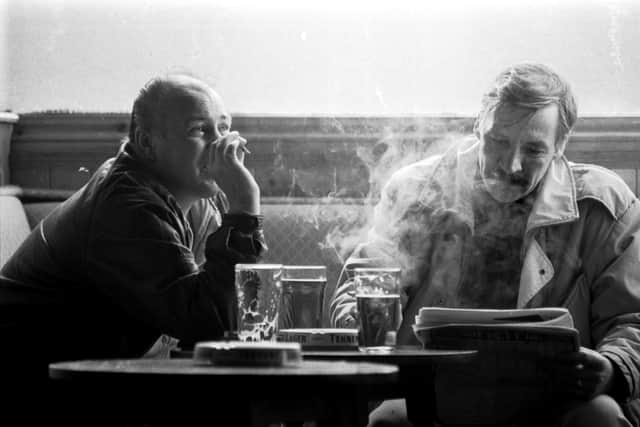

Changing the habit of several lifetimes wasn’t easy. That’s why it took legislation to make a real, and lasting, difference.
In 2006, a Scottish Executive - now the Scottish Government - survey revealed that 33% of Fife’s population smoked, with 14% smoking at work as a matter of routine.
The human cost was clear - smoking was attributed to 750 deaths, 4600 hospital admissions and cost NHS Fife £10million.
While work places managed the transition to smoke free premises – which also included a ban on lighting up while driving a company vehicle – pubs and clubs were more of a challenge. Old habits died hard, and the licensed trade had many misgivings about the legislation.
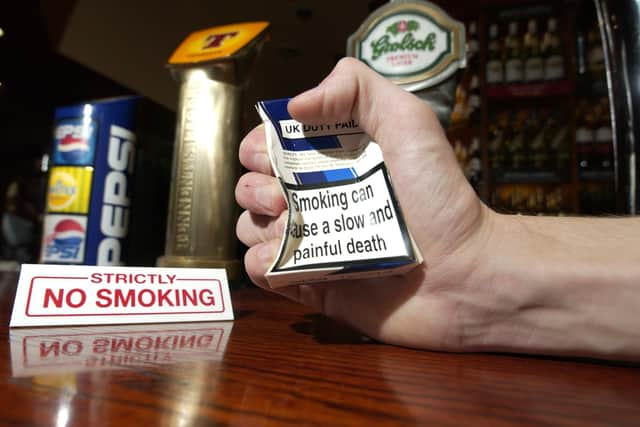
Bar owners worried about how it might affect their business. Pubs which sold food saw the benefits straight away - more customers enjoying a meal without the pall of smoke from the next table - but traditional working men’s pubs were different, and some feared the worst.
Liz Tomlinson then landlady at the Path Tavern, told the Fife Free Press in 2006: “Most of my customers like to come here for a pint and a cigarette, and many of them are already complaining they won’t be able to smoke in the pub. It would be okay if the Scottish Executive gave us the choice of being a smoking or non smoking pub, but it didn’t”
Sandy Haxton, mine host at Betty Nicols, predicted a short term drop in trade for many, but one that would soon be recovered.
“I am probably in the minority as I don’t see why people should have to work in a smokey environment,” he said. “Commercially it could have an adverse effect - I think there will be a sharp downturn initially, but things will come up again as everyone is on a level playing field.”
One of the biggest gripes among publicans was the confusion over how they could accommodate smokers.
The Penny Farthing in Kirkcaldy’s High Street was the first to get approval for an outdoor area, but many owners were worried over what they could, and could not do, under the new legislation.
The late Remo Maciocia, who ran the Candle Rooms and Harlem on the Esplanade, said: “The biggest problem we are facing is that the authorities don’t know what hey are meant to be doing. We have asked them to allow us to have controlled areas where people can go and smoke. They seem to have bene caught on the hop, and don’t seem sure what is allowed, and what is not.”
Fife Council said legislation made it clear - if a space has a roof and it is enclosed over 50% of its size then it it is an enclosed space and the ban would apply
In the countdown to the new legislation, an extra £300,000 was allocated over three years to help the local authority enforce it, while NHS Scotland launched a major stop smoking campaign.
The Scottish Executive had public support firmly on its side - which is why the change was so transformative.
Two decades on, the benefits are clear.
There has been a 17% reduction in adult heart attack admissions to Scottish hospitals, reversing a previous rising trend, and an 18% decline in child asthma admissions. Second-hand smoke exposure among bar workers also reduced by 86%.
Sheila Duffy, chief executive of ASH Scotland, said: “Scotland’s UK-leading smoke-free public spaces legislation was a major public health success in encouraging many people to give up smoking and driving down the dangerous exposure of toxic second-hand smoke for staff and customers, including children, in indoor settings. “We are delighted to celebrate what is considered one of the most important public health measures in the first quarter of the 21st century and a landmark achievement of the devolved Scottish Parliament. We hope its success encourages the next generation of MSPs to further extend smoke-free protections especially to areas most used by children such as in playgrounds, around schools and in sporting facilities.”
Roz Foyer, general secretary of the Scottish Trade Unions Congress (STUC), hailed the ban as
“Protecting workers in their workplace is a core principle of our movement,” she said. “We’re proud to have helped deliver improved health outcomes and a safer working environment for bar workers and hospitality staff across Scotland and will continue to build on that work as this leading legislation marks its 20th anniversary”
Gareth Brown, policy and public affairs officer for Asthma + Lung UK Scotland reflected on the controversy of the time, and the reality of today where simply no-one snmokes in an office, a pub, or even a work vehicle.
"The ban ensured that smoking inside public places has thankfully ceased, with the link between socialising and smoking broken,” he said., “Since then, generations of young people have never started smoking and have largely avoided the harms caused by passive tobacco smoke. This has helped to bring down smoking rates, but there is much still to be done, particularly in more disadvantaged area. Scotland needed this ban to improve the nation’s lung health, and our fight continues to help everyone breathe better.”