
VJ Day: Kirkcaldy’s simple service 80 years after bonfires and fireworks celebrations

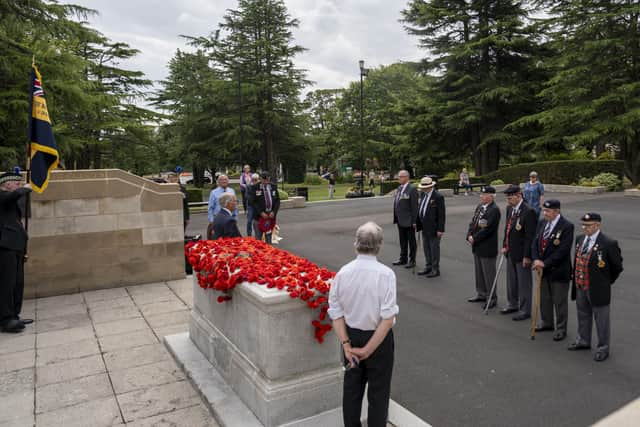
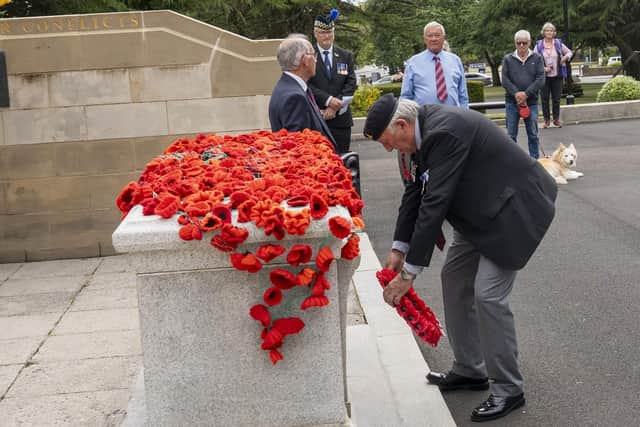
Eighty years to the day World War Two formally ended, a small gathering of ex-servicemen stood in silent tribute at Kirkcaldy’s War Memorial.
In a simple, dignified ceremony, they remembered those who made the supreme sacrifice. Wreaths were laid as the bell at the Town House struck midday.
Organised by the Kirkcaldy branch of the Royal British Legion, the gathering paid tribute to one of the most significant dates in our calendar - August 15, 1945, when the Japanese surrender signified the end of hostilities.
The midday ceremony was in stark contrast to the midnight celebrations in Kirkcaldy which heralded the arrival of peace 80 years ago. Bonfires, fireworks and floodlighting were how the Lang Toun celebrated.

Euphoria followed the broadcast by Prime Minister Clement Atlee that Japan had accepted the terms of surrender. Given the lateness of the hour, many had retired to bed, but, reported the Fife Free Press, after Mr Atlee’s broadcast, “Kirkcaldy suddenly became alive.”
Ships’ sirens set up a wailing note from the Forth, the noise of the fireworks increased, and revellers started to walk through the streets singing and cheering. Bonfires were lit in various parts of the town, many of them in the middle of streets, and impromptu dances were held.
“The sounds of revelry carried well into the wee sma’ hours of this rather sudden VJ morning,” noted the Press.
The following morning heralded the start of a two-day holiday break. Crowds thronged throughout the High Street, but, said the Press, “in most parts of the town, housewives were busy queueing up for foodstuffs while their menfolk, assisted by the youngsters, started on the decorations.”
Barry, Ostler & Shepherd’s Band, Dysart Colliery Band and the pipes, brass and bugle bands of the Boys’ Brigade took part in separate programmes of music in various parts of the town, and the celebrations reached their height in the evening when bonfires, piled up by willing hands earlier in the day, were lit.
“There was a line of such bonfires stretching from the harbour right along the Esplanade to Seafield, and all available points throughout the burgh,” reported the Press. “Open air dancing was held, this again being on a general scale whilst the floodlighting of the war memorials at Kirkcaldy and Dysart was another attraction.”
But for those keen to raise a glass in celebration, there was bad news - many licensed premises did not open, while others didn’t stay open for long. Noted the Press: “In the early evening a liquor famine was settling down on the Lang Toun as supplies simply could not cope with VJ celebrations.”
VJ+1 Day which followed also saw the town almost without buses, making it hard for those not on holiday to get to work. In the forenoon, only one town bus - the number two - ran and it “gallantly plied from Junction Road to Invertiel in splendid isolation. The town’s other five routes had no buses.
Looking back on the historic day, the Press summarised: “Kirkcaldy can pride itself that it celebrated the end of hostilities in fitting style. There was no sign of the over exuberance which has marred festivities in some quarters of the globe, and a good time was had without the peace being unduly disturbed.
A victory message was also relayed to Kirkcaldy citizens by Baillie John A.M. Collyer, JP Acting Chief Magistrate in which he said: “May I, on behalf of the Town Council, extend to you the citizens of Kirkcaldy, our congratulations on the declaration of peace, and our grateful thanks for all you have done in assisting forwards the victorious conclusion of the war.
“I would further express our deep gratitude to the sailors, soldiers and airmen of the Burgh who have fought in the various theatres of war, and especially do we remember those who have made the supreme sacrifice for our freedom.
“There are many difficult tasks ahead but I am sure that the council can rely on the wholehearted support of the citizens to overcome these problems.”
The view echoed with the Press’ own editorial comment which said: “Whether the peace which has thus been secured will become permanent depends on the people themselves. If we can bring to bear on the ordinary affairs of life the same enthusiasm and selflessness that characterised our people in the times of difficulty if danger and crises of the past six years, then there remains a bright new hope for mankind.”