
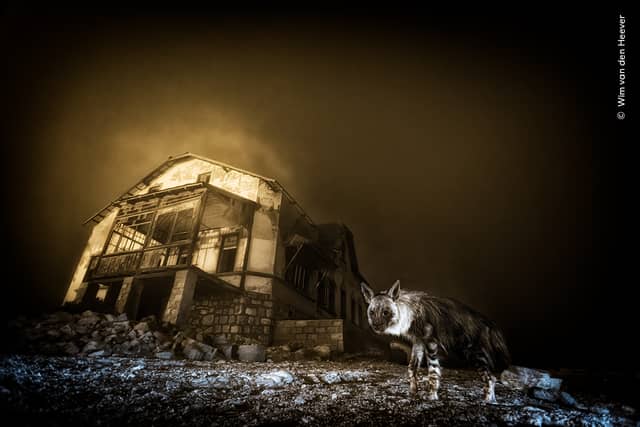


A haunting snap of a rarely-seen hyena passing through a mining ghost town has earned its creator the 2025 ‘Wildlife Photographer of the Year’ title.
The winners of the prestigious competition – which is developed and produced by the Natural History Museum – and each of its diverse categories were unveiled at an awards ceremony in London on Tuesday night (October 14). This year’s grand prize went to South African wildlife photographer Wim van den Heever, for his powerful image ‘Ghost Town Visitor’.
Van den Heever, who also won the ‘urban wildlife’ division, captured the elusive brown hyena – the rarest hyena species in the world – passing through a long-abandoned diamond mining town in Namibia. The photo was taken using camera trap technology, the culmination of a decade of trying.
Jury chair Kathy Moran said that she got a prickly feeling just looking at the image. “You know that you’re in this hyena’s realm. I also love the twist on this interpretation of ‘urban’ – it was once but is no longer a human-dominated environment. Abandoned by miners, wildlife has taken over. Repopulated, if you will. Is it still a town – it would seem that way to me – just no longer ours.”
Other division winners include a stark snap of a longhorn beetle looking out over an abandoned digger; an orphaned giant anteater pup tottering after its caregiver; and a UK photo of an orb weaver spider tucked away in its web on a frosty September morning – the winner of the under-10s category.
All of these entries – and more – will be available to view at the Natural History Museum in London, with the exhibition opening on Friday (October 17), and running until July 12 next year. It will then embark on a UK and international tour, the Museum says, “to inspire millions to appreciate and conserve the natural world”. You can buy tickets to the initial exhibition online here.
Here are a few of the 2025 winners in some of the competition’s key categories, each of which shows off a different facet of the natural world in all of its glory:
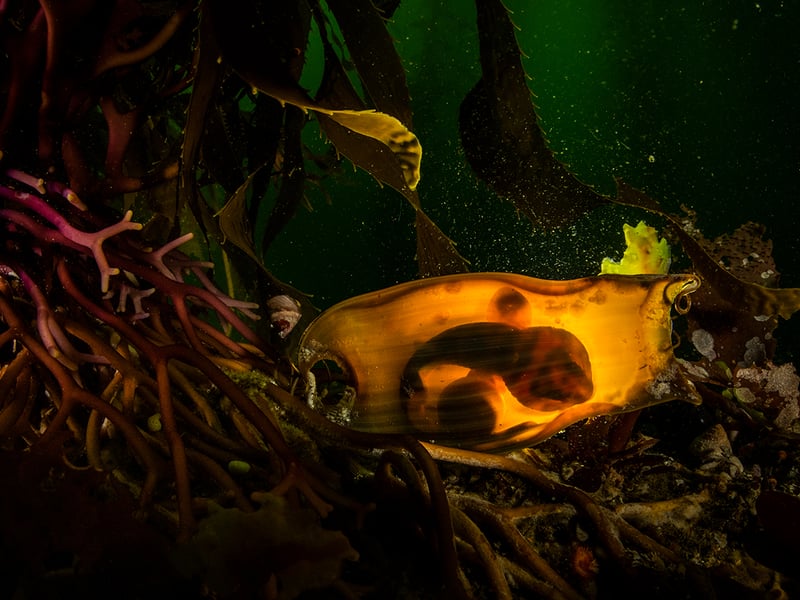
5. Survival Purse - Winner, Underwater
Ralph Pace (USA) beautifully illuminates the egg case of a swell shark, tethered to the base of a giant kelp. Faced with strong currents pushing him from side to side, Ralph struggled to keep steady to photograph this egg case, or ‘mermaid’s purse’. He lit the case from behind to reveal the swell shark embryo within, its gill slits and yolk sac clearly visible among the dark kelp forest. | Ralph Pace (USA)/Wildlife Photographer of the Year
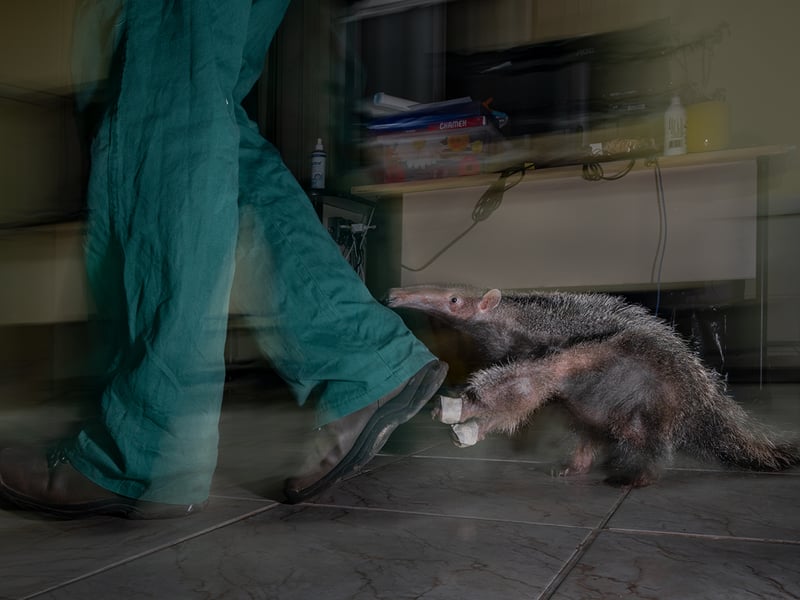
6. Orphan of the Road - Impact Award Winner 2025
Fernando wanted to highlight the consequences of road collisions, a leading cause of the decline in giant anteater numbers in Brazil. This pup’s mother was killed by a vehicle, and the hope is that it will be released back into the wild after being encouraged to develop crucial survival skills by its caregiver. Alongside rehabilitation centres, the Anteaters and Highways project of the Wild Animal Conservation Institute is developing strategies to reduce anteater deaths on Brazil’s roads. These include erecting fences and building underground tunnels to allow the anteaters to cross safely. | Fernando Faciole (Brazil)/Wildlife Photographer of the Year
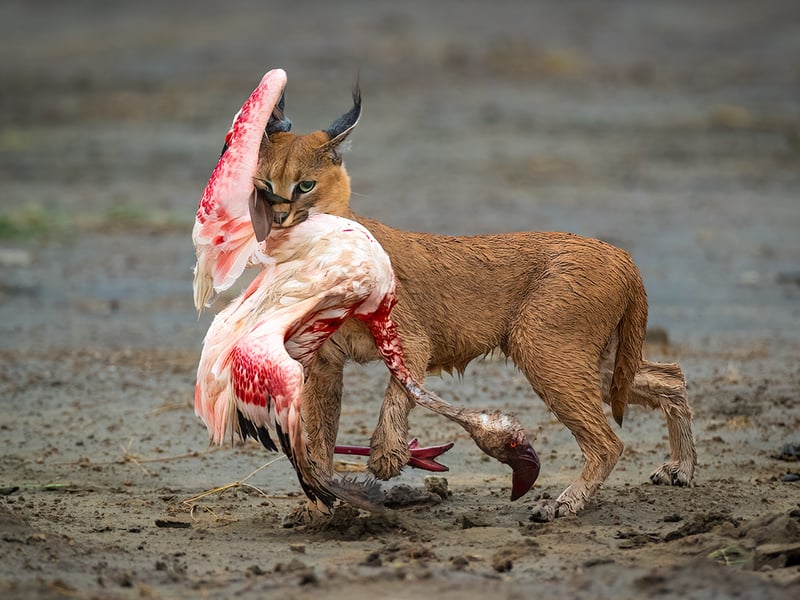
7. Cat Amongst the Flamingos - Winner, Behaviour: Mammals
Dennis had been keeping an eye out for wild cats such as servals for several days when a call came over the radio: one had been seen at Ndutu Lake. But it wasn’t a serval. It was a caracal, successfully hunting wading lesser flamingos. Caracals have a varied diet, from insects to antelope, and are renowned for the acrobatic leaps they make to snatch birds from the air. But there are few, if any, records of them hunting flamingos | Dennis Stogsdill (USA)/Wildlife Photographer of the Year
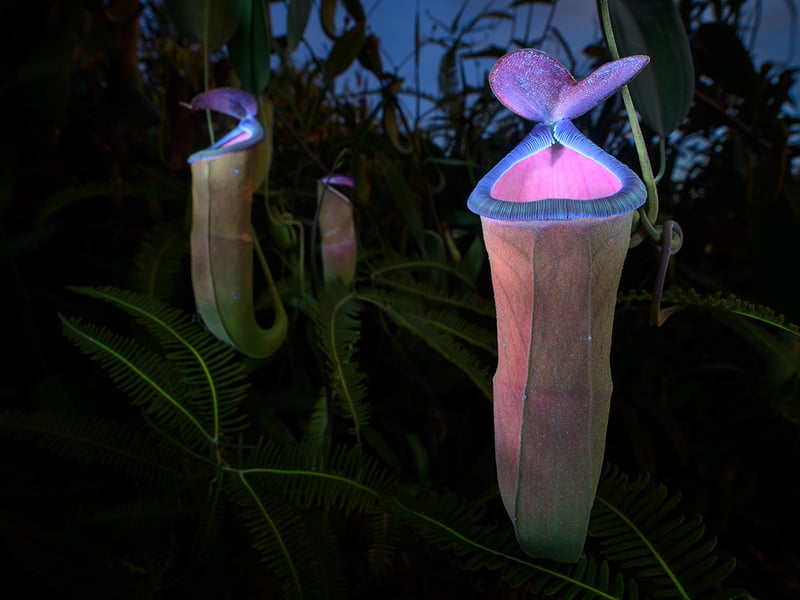
8. Deadly Allure - Winner, Plants and Fungi
Chien Lee (Malaysia) uses a UV torch to reveal the fluorescent world of an insect-attracting pitcher plant. Insects can see ultraviolet (UV) light, but humans can’t, so Chien used a long exposure and a UV torch. Waiting until after sunset, he had just a five-minute window before the ambient light illuminating the backdrop disappeared completely. Some carnivorous pitcher plants reflect UV light on certain areas as part of their ‘display’. They use colour, scent and nectar to lure their prey into pools of digestive juices at the bottom of their leaves. | Chien Lee (Malaysia)/Wildlife Photographer of the Year