
Kinghorn beach: calls for action after poor rating leads to ‘no bathing’ alert

Politicians have demanded action after a “don’t go in the water” alert at Kinghorn’s Harbour beach after it failed quality tests for a fifth time.
Permanent advice against bathing in the waters at the popular beach is set to be issued following the most recent rating from the Scottish Environment Protection Agency (SEPA).
It will remain in place until water quality is improved.
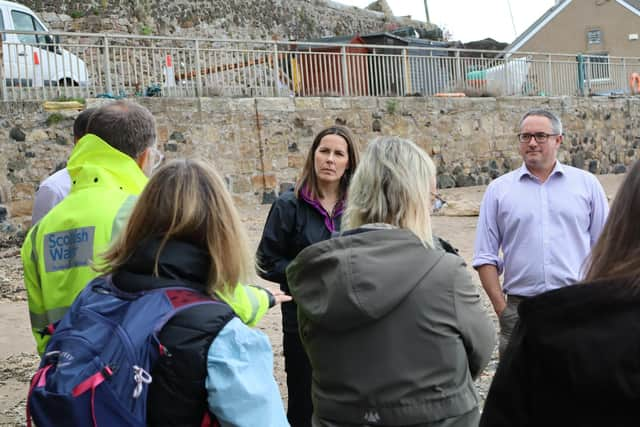
The news comes just weeks after Scottish Water’s chief executive, Alex Plant, came to the town to meet locals at the invitation of Melanie Ward, MP for Cowdenbeath and Kirkcaldy, and promise that even if the beach failed the latest Scottish Environment Protection Agency (SEPA) assessments, he was committed to fixing the decade-long problem.
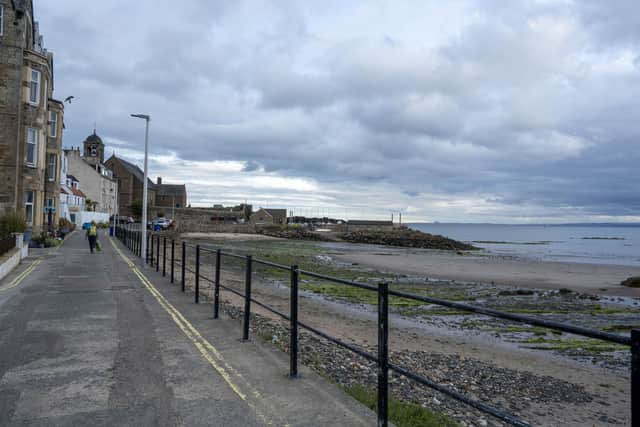

The issue has been a major concern to locals for a long time, and they presented Mr Plant with a 1000-strong petition calling for action to tackle the contamination leaks at the Lady Burn.
The harbour beach was one of two in Fife to get a poor rating - Lower Largo also received the lowest classification.
Politicians have stepped up their demands for action from Scottish Water and the Scottish Government.
Melanie Ward, MP for Cowdenbeath and Kirkcaldy, said: “It’s truly shocking that it has come to this; years of raw sewage leaks with no solution mean that Kinghorn Beach will now no longer be classed as a bathing water.
“Sewage from human faeces leaking onto the beach has been known about by the authorities - Scottish Water and the Scottish Government - for more than a decade. As water bills have gone up, they have failed to take appropriate action to stop this from happening. It has made local people and pets ill.”
She added: “When I brought the Scottish Water CEO to the beach last month, he made a public commitment to take the radical action that may be required to clean up our beach. This can’t happen soon enough - residents, tourists and local businesses are all depending on it.”
Claire Baker MSP for Mid Scotland and Fife described the news as “hugely disappointing.” She added: “It is particularly frustrating for a community that has waited so long for this problem to be properly addressed as this means it will lose its official bathing water designation.
“Losing the formal designation must not mean losing the focus on finding and fixing the source of the pollution. Kinghorn Harbour Beach is a fantastic asset to the town and the wider Fife coast. Residents, swimmers and visitors deserve to enjoy it, and I will continue to press for Scottish Water to deliver on its commitments and get the water quality back to where it should be.”
Mark Ruskell, Scottish Greens MSP for Mid Scotland and Fife said: “
Scottish Government must protect our seas and bring forward clean water bill
Mid Scotland and Fife MSP Mark Ruskell has called on the First Minister to bring forward a clean water bill to protect our rivers and waterways.
This call comes following the fifth consecutive year of poor water quality results at Kinghorn Harbour Beach, which is likely to result in the beach losing its bathing water designation.
Kinghorn Harbour Beach has been a designated bathing spot since 2008, however the water quality has long been at risk of pollution from sewage overflows and surface water discharges, which are exacerbated by heavy rainfall. Whilst Scottish Water spent £700,000 in 2018 to prevent sewage spills from the Lady Burn catchment, this has not been enough to improve water quality sufficiently due in part to a number of rogue connections to the sewage network.
Mark Ruskell MSP for Mid Scotland and Fife said: “The loss of bathing water designation is devastating for the Kinghorn community and all those who love this place. “While the First Minister insists there is no flaw in current legislation, I disagree. Scottish Water and SEPA’s commitment to solve the problems at Kinghorn are admirable, but it’s clear a change in the law is needed to deal with rogue sewage connections and many other issues, otherwise why have the pollution issues at Kinghorn been allowed to get to this stage? “We need the government to bring forward a clean water bill which will guarantee that all our rivers, seas and waterways are clean, safe and free from pollution.”
A spokesperson for SEPA said: “We recognise that these results will be disappointing for local communities and are continuing to work with regulated operators and partners to identify the most effective improvements alongside investigating the sources of pollution.
At Lower Largo, Scottish Water was required by SEPA to install improved wastewater treatment works during the 2026 bathing season, providing secondary treatment. Initial indications are very positive, and SEPA is continuing additional monitoring to assess whether the investment is delivering the expected benefits, and that water quality has improved to consistently meet bathing water standards.
“Despite previous investigations and completed improvement measures, the sustained improvement required has not been achieved. SEPA are issuing a further regulatory notice requiring Scottish Water to continue investigations and improvement actions and water quality monitoring will continue as necessary. ”
Thirteen of Fife’s 15 designated bathing waters were classified as good or excellent.
Scotland’s bathing water season runs from June 1 to September 1 every year, when SEPA carries out regular water quality monitoring at designated bathing waters.
The annual classifications reflect both monitoring carried out during the 2026 bathing season and a longer-term picture of water quality across Scotland's beaches and inland bathing waters. Unlike individual water samples, which show conditions at a particular point in time, bathing water classifications are calculated using four years' of monitoring results.
The full ratings were:
Excellent - Aberdour Silver sands, Anstruther (Billow Ness), Crail (Roome Bay), Elie (Harbour) and Earlsferry, Elie (Ruby Bay), Kingsbarns, St Andrews East Sands.
Good - Aberdour Harbour Black Sands, Burntisland, Kinghorn Pettycur, Kirkcaldy Seafield, Leven, St Andrews West Sands
Poor – Kinghorn Harbour beach, Lower Largo
Dr Ruth Stidson, principal scientist for Bathing Waters at SEPA, said: “Most of Scotland’s bathing waters continue to meet the required standards, and that’s encouraging. But we know that for people who care about their local beach, the national picture isn’t the whole story.
“Where water quality isn’t good enough, people rightly want to understand why and what’s being done about it. Improving bathing water quality can be complex. Pollution doesn’t always come from one obvious source, and what works at one location won’t necessarily work somewhere else.
“That’s why our monitoring and scientific investigations are so important. They help us understand where pollution is coming from and ensure that evidence informs the action needed.”